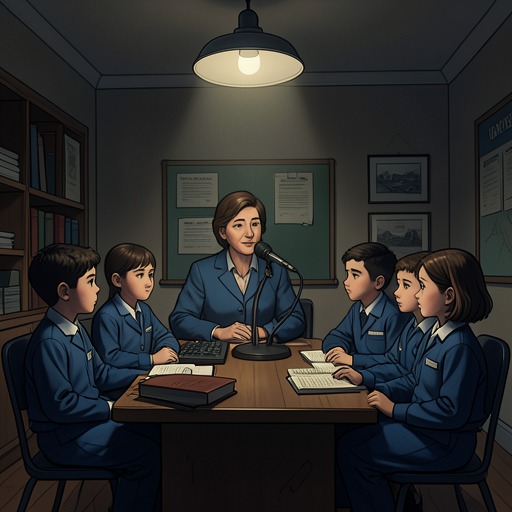
The conflict between protecting students and telling them the truth
Never Let Me GoThe conflict between protecting students and telling them the truth is a defining ethical dispute in the history of Hailsham. Miss Lucy believes the students should understand what lies ahead, who they are, and what they are for; Miss Emily argues that withholding that knowledge preserved their happiness and gave them a childhood. The disagreement is not simply about whether the students should know facts. It concerns whether protection can justify deception when the truth would shape how they live, and whether a sheltered life is still a gift when its limits have been concealed.
The dispute at Hailsham
Miss Emily recounts the disagreement after Kathy H. and Tommy ask what happened with Miss Lucy. For Miss Emily, Miss Lucy’s challenge was an internal matter at Hailsham: she believed the students had to be made more aware of their future and should receive as full a picture as possible. She considered anything less a form of cheating. Miss Emily acknowledges that Miss Lucy meant well and had the makings of an excellent guardian, but says the guardians judged her approach mistaken. Their years of running Hailsham had, in Miss Emily’s view, taught them what would work for the students in the long run, including after they left the school.
Miss Lucy’s position gives the students’ knowledge an ethical importance of its own. She does not treat their future as something they should be shielded from simply because it is painful. Her insistence that they understand who they are and what awaits them challenges a model of care in which adults decide that ignorance is kinder. Miss Emily’s account nevertheless makes clear that the disagreement concerns competing ideas of responsibility, not a simple opposition between concern and indifference: she says Miss Lucy meant well, while maintaining that her proposed honesty would have harmed the students.
Miss Emily’s case for shelter
Miss Emily defends Hailsham’s policy by naming its costs plainly. She admits that the guardians kept things from the students and lied to them, even conceding that they fooled them. She presents this concealment as the means by which Hailsham gave them something lasting: their childhoods. Had the students fully understood what lay in store, she argues, they would have regarded their lessons and creative work as pointless, and their happiness at Hailsham would have been shattered.
Her defense rests on a particular account of what the school made possible. The students could become absorbed in lessons, art, and writing because they were sheltered from the full force of their future. Miss Emily insists that this experience formed them: Kathy and Tommy would not be who they are, she says, without the protection Hailsham gave them. The same concealment therefore appears in her telling as both deception and care. Its moral difficulty remains visible precisely because she does not deny the deception; instead, she argues that the childhood it secured was worth the price.
Miss Lucy’s removal marks the institutional consequence of this disagreement. Miss Emily says that, if Miss Lucy had had her way, the students’ happiness would have been broken, and concludes that she had to go. The school thus resolves the conflict not by combining greater honesty with continued protection, but by rejecting the guardian who wanted to tell the students more. Miss Emily’s retrospective explanation offers a rationale for that decision, while leaving the students to reckon with the consequences of what they were not told.
Care in adult life
Kathy H.’s later experience as a carer gives the conflict a personal dimension. She describes care as demanding emotional judgment: a carer must know when to stay with a donor, when to leave them alone, when to listen, and when to encourage them to pull themselves together. Kathy takes pride in helping donors remain calm and recover better than expected. Her account suggests that care depends not only on formal duties but on attention to another person’s changing needs.
That work also has limits. Kathy says that carers are not machines and that patience and energy wear down. The work is harder when she lacks a deeper connection with a donor, which helps explain why she chooses people from Hailsham and other privileged backgrounds when she is allowed to choose. Reconnecting with Ruth and Tommy is part of the significance of that choice: personal ties bring her close again to people who share memories of growing up at Hailsham. Care can restore intimacy and recognition, but Kathy’s own account does not suggest that it can undo the future the students were raised to face.
The limits of protection
The tension between comfort and truth persists in Kathy’s relationship with Tommy. When he asks whether she ever grows tired of being a carer and wishes she would receive notice to become a donor, she answers that good carers matter. Tommy counters that all donors will donate and then complete, whether or not they have a good carer. His challenge exposes a limit in the language of protection: kindness can ease suffering, but it does not alter the system’s promised outcome.
Together, Miss Emily’s defense of Hailsham and Kathy’s caregiving make protection neither wholly false nor wholly sufficient. Hailsham gave its students a childhood shaped by lessons, art, and shared attachments, but it did so while withholding knowledge that Miss Lucy thought they were entitled to receive. Later, Kathy offers donors attentive, relational care, yet the work remains bounded by their unavoidable fate. The conflict endures because the narrative refuses to make either form of care erase the cost of concealment: shelter can preserve happiness for a time, and companionship can make suffering less lonely, but neither answers what the students might have chosen if they had been told more.